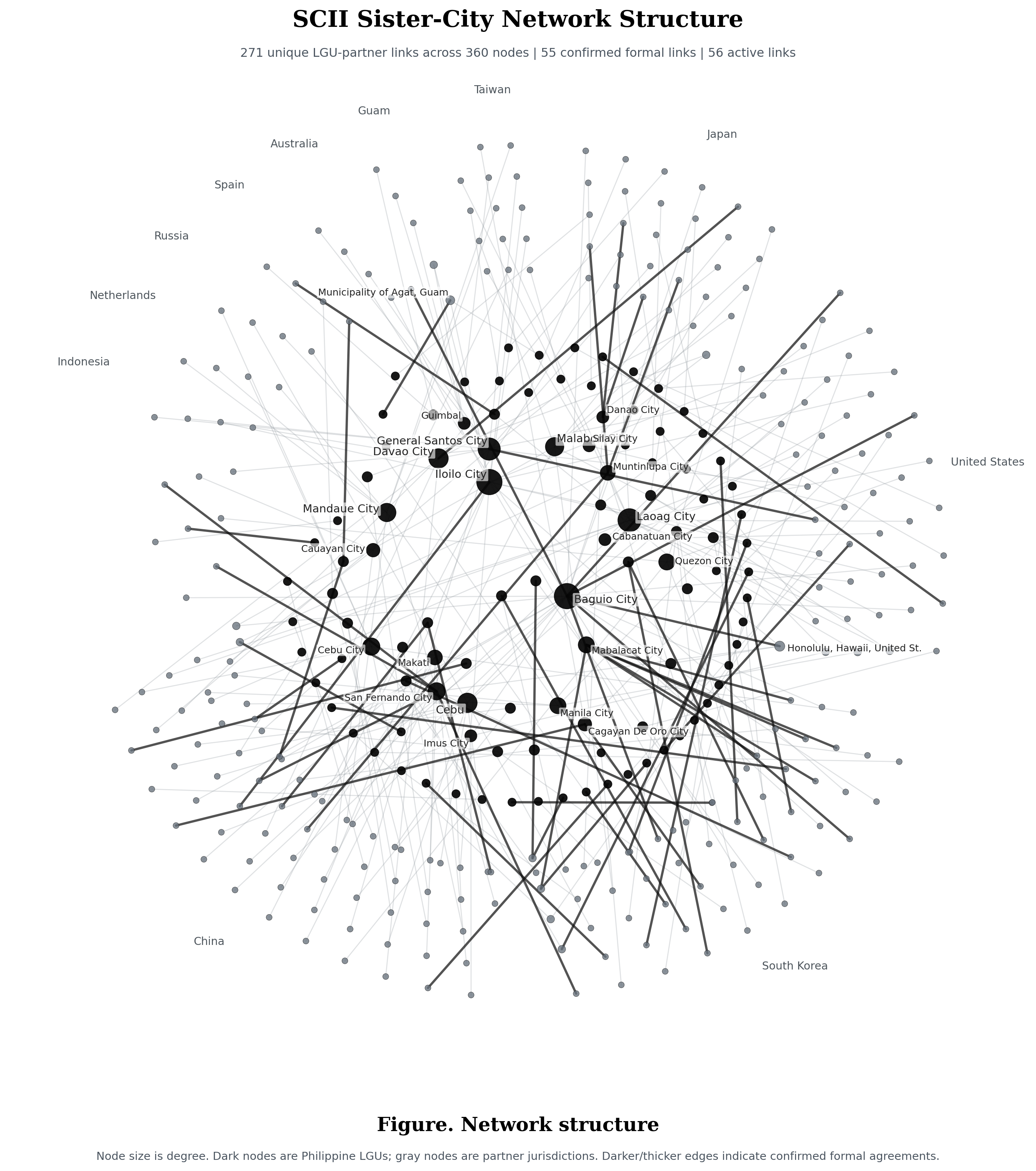
Network map of Philippine LGUs and sister-city partner jurisdictions

ULAP's Sister City Integrity Initiative / May 2026

Soft diplomacy can produce hard market consequences.

Sister-city and local cooperation instruments may be non-binding, but they can still shape access, expectations, data exposure, procurement proximity, and public-sector risk before any formal transaction is filed. This report maps 271 Philippine LGU sister-city and town-twinning records to show where partnerships sit, what remains undocumented, and when ceremonial cooperation begins to create market, labor, data, financial, or asset exposure.

Evolution of sister-city practice

Agreement forms moved from friendship files toward sectoral and market-facing portfolios.

The sequence shows how sister-city records moved from friendship and protocol files toward clause-bearing, sector-specific, and market-facing instruments. The administration view keeps partner-country shifts visible because the portfolio changes by both form and corridor.

Agreement record growth and clause-bearing instruments

Annual records with 3-year average

Source: scii_context_timeline_year_counts.csv. Bars show all dated records and records with operative or sector clauses; the line shows a trailing 3-year average.

Partner-country mix by administration period

Click a year for detail

Source: Complete_Agreement_List.csv, using date signed, effective date, or source-document date where available.

Sister-city process

A partnership should become visible before it becomes operational.

The route follows a control logic: identify the file, check local authority, verify the counterpart, route sector triggers before implementation, disclose key terms, then monitor renewal or exit.

Portfolio shape

Four partner-country corridors account for more than three quarters of records.

China, South Korea, the United States, and Japan account for 203 of 271 relationship-level records. The chart keeps the long tail visible because smaller clusters still matter for registry design.

Partner-country distribution

Total corpus: 271 records

Source: Canonical Dataset Summary and local Complete_Agreement_List CSV.

Top corridor profiles

The four largest corridors behave differently.

The record count is only the starting point. Each large corridor has a different operating profile, which is why the registry should route by sector, clause, and evidence need rather than by nationality alone.

Documentation visibility

Most relationships remain hard to verify at the operative-text and monitoring layers.

Operative agreement visibility

Formal agreement present vs. not documented

55 of 271 records have confirmed operative agreement text.

Implementation status

Active relationships remain difficult to read without follow-through files

Implementation status is unclear in 214 records.

Monitoring evidence

Progress records are the thinnest layer

Only 19 records show monitoring or progress evidence.

Market integrity

The screen highlights exposure pathways, not allegations.

These indicators are routing signals for document recovery, sector review, public-private dialogue, and scorecards. They are not findings of misconduct, corruption, espionage, or national-security breach.

Exposure triggers

Records with visible trigger or review flag

Source: SCII Market-Integrity Computation, 271-record denominator.

Market exposure level

Distribution of screening level

Moderate/high exposure requires sector routing, not accusation.

Country associations

Function and evidence visibility explain more than instrument form.

Bias-corrected Cramer's V is largest for labor trigger status, LGU type, island group, and operative-text visibility. Instrument form is small and non-significant in the full partner-country test.

Partner country by selected field

Bias-corrected Cramer's V

The association test shows partner-country patterns are more strongly linked to labor triggers, LGU type, island group, and operative-text visibility than to instrument form. The governance issue is functional and evidentiary, not just a matter of formal labels.

Source: scii_network_method_tests_canonical_20260528.csv.

Country positioning matrix

Commercial orientation vs. exposure/safeguard sensitivity

This matrix is diagnostic, not a country ranking. It reads the whole portfolio first: the x-axis captures market-facing cooperation orientation, the y-axis captures exposure and safeguard sensitivity, and bubble size captures relationship-record count.

Source: country_presentation_filter_audit.csv. Bubble size reflects relationship-record count; x-axis is cooperation orientation and y-axis is exposure/safeguard sensitivity.

Anonymized case carousel

Case examples show why the same instrument label can require different documentation.

These examples are drawn from the report and the event-log comparison file used in the study. They are included to illustrate documentation needs and registry routing logic. Philippine counterpart names are anonymized.

Registry preview

A registry can turn selected facts into a routing slip and standard clause set.

This preview shows the operating logic behind a future SCII registry. Tick the partner, sector, and missing provisions; the page generates a draft routing tier, review path, and standard clauses that a public file should require before implementation.

Partner corridor
Sectors activated
Missing or weak provisions

Recommendation package

The latest reform package is firewall-led, not registry-led.

The current Section 10 makes the sister-city to project firewall the governing rule. The registry, one-page screen, sector routing, and model clauses are support tools: they make the firewall visible, tell the LGU when it has been triggered, and route activated functions to the office already authorized by law.

Bottom-line operating rule

Register all. Treat umbrella instruments as non-executing.

Log baseline civic activity lightly; route triggered functions; deep-review only higher-sensitivity or evidence-deficient files; monitor conversion events; and pilot the administrative burden before national rollout.

Source: current SCII report, Section 10.1-10.11 recommendations and bottom-line operating rule.

Comparative scale

The active Philippine LGUs are fiscally stronger than average, but still smaller than major counterpart systems.

The comparison layer keeps two asymmetries separate: international fiscal scale from WOFI, and domestic Philippine LGU capacity from SRE income and expenditure data.

WOFI subnational revenue benchmark

Dollars PPP per inhabitant, 2020

Source: official SNG-WOFI country profiles. U.S. row uses SNG total because the profile does not split state and local revenue.

SCII LGUs versus Philippine LGUs

2020-2024 means

Source: scii_sre_lgu_income_20260525 summary outputs.

Where SCII LGUs spend differently

Mean expenditure share, percent of current expenditure

Positive bars mean SCII LGUs spend a higher share than the national LGU mean.

Top SCII LGUs by mean income

PHP millions, 2020-2024

Ranking uses matched SCII LGUs in the SRE local finance panel.

Policy brief

Upstream of the Rules: Market Integrity in Philippine Sister-City Agreements

A sister-city agreement is easy to sign and difficult to govern once the signing ceremony ends. The SCII portfolio maps 271 documented Philippine LGU sister-city and town-twinning records and finds that the core problem is not the existence of local cooperation itself, but the lack of post-signature visibility: many relationships show ceremony, listings, or activity without the operative text, implementation record, monitoring file, or downstream authority needed to test what actually followed.

The portfolio is small but concentrated in market-visible jurisdictions. Only 105 of the Philippines' 1,724 LGUs appear in the records, and four partner countries account for 203 of the 271 relationships, or 74.9 percent: China, South Korea, the United States, and Japan. These records are review flags, not findings of misconduct. They show where market access, technology and data, labor mobility, value flow, donations, public naming, or procurement-adjacent activity may arise before ordinary procurement, audit, labor, data-protection, and sector controls become visible.

The recommended control is to treat every sister-city, friendship-city, town-twinning, MOU, MOA, renewal, or side-letter instrument as a non-executing umbrella. It may record cooperation and intent, but it should not itself authorize spending, procurement, labor deployment, data sharing, asset acceptance, technology adoption, public-safety activity, or public messaging. Downstream action should proceed only through the Philippine legal instrument and agency route that the activated function already requires.